- Structural change is a type of organisational change that involves a profound realignment of the organisation to address performance or survival issues.
- The success of such a transformation depends on secure execution and the ability to make quick decisions.
- The impact on employees, processes, and culture must be managed pragmatically to avoid operational paralysis.
- The use of interim management helps stabilise the company and guarantee measurable results within a limited time frame.
S\\\\\\\\\\\\\\\\\\\\\\\\\\\\\\\'engager pour votre sérénité



Structural change: driving transformation
09 Mar
Posté par : Clarisse Maitre
Category: News, Strategy guides
Aucun commentaire
![[Header article] changement structurel](https://www.delville-management.com/wp-content/uploads/2026/03/Header-article-changement-structurel.png)
Key takeaways
Faced with market disruptions, structural change is no longer a matter of adjustment, but of necessity. For leaders, the challenge goes beyond simply reorganising the organisational chart: it is about transforming the architecture of the company to ensure its sustainability.
What is structural change in business?
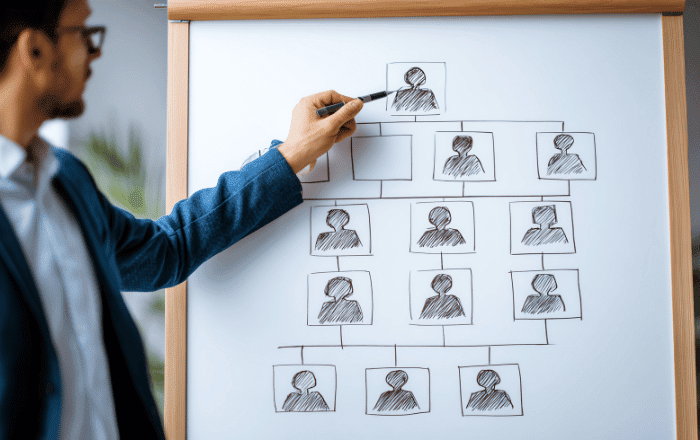
Structural change refers to a profound, comprehensive, and lasting change in the structure of an organisation. Unlike marginal adjustments, it impacts the foundations: hierarchy, distribution of power, and coordination methods.
There are generally several types of structural changes:
- Functional restructuring: overhauling reporting lines to increase agility.
- Mergers and acquisitions: integration of entities requiring rapid harmonisation of systems and cultures.
- The transition to a matrix organisation: combining sector expertise and local roots.
The goal is to restore operational efficiency in high-stakes situations, often marked by time or financial pressure.
Why initiate structural change? Key triggers
The decision to initiate a structural change responds to critical disruptions in the company's life cycle:
- The obsolescence of the current model: a decline in profitability often indicates that the structure is hindering performance.
- Hypergrowth or transformation: the transition from SME to mid-sized company requires restructuring functions to ensure smooth execution.
- Crisis or turnaround: in an emergency, changing the structure is the main lever for safeguarding the business.
In these situations, the ability of leadership to actually drive transformation, and not just define it, is the key factor for success.
The impacts of structural change within the company
A change of this magnitude requires a profound transformation of organisational dynamics.
- Employees and positions: Areas of responsibility are changing, requiring human resource management focused on the peace of mind of customers and teams.
- Operational processes: Information flows must be realigned to avoid managerial vacancies or loss of control.
- Corporate culture: The transition to new models requires leading by example and a strong results-oriented culture.
Example: An industry shifting toward agile production must not only adapt its technical tools, but above all, evolve its management styles toward modes of leadership focused on immediate execution.
How to make structural change a success? From strategy to execution
Many transformations stop at the theoretical stage. For decision-makers, the value lies in actual management.
- Define a clear vision: objectives must be factual and oriented toward measurable results.
- Securing execution: this is where using an interim management firm brings distinctive added value. By bringing in experienced interim managers (C-level), the company ensures immediate operational responsibility. Our firm can provide qualified candidates within 72 hours.
- Acting responsively: in critical situations, the ability to react quickly is a strategic necessity for maintaining continuity.
Managing risks and obstacles during the transition
Any structural change generates resistance. The major risk is that implementation will be blocked or fail. To overcome these obstacles:
- Adopt a peer-to-peer approach: proven experience is more credible than academic models.
- Be factual and reassuring: clear information limits uncertainty during the transformation.
- Take operational responsibility: in uncertain times, the organisation needs leaders who can make decisions and implement them.
Making structural change a driver of sustainable growth
Structural change is a necessary step for the growth and resilience of a company. While it represents a human and financial challenge, it also provides an opportunity to modernise governance and secure execution. By drawing on responsive operational expertise, leaders transform these complex situations into measurable results.
Sources :
- Organisational change: the keys to successful project management, Anact report. (FR)
- Change management – Stéphanie Missonier (FR)