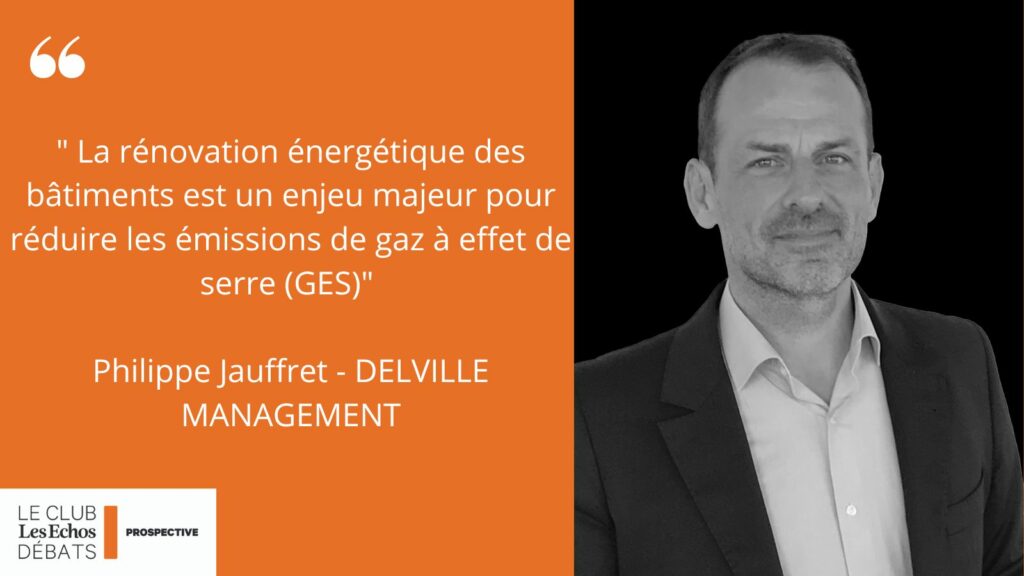
Le Club Les Échos Débats – Prospectives a reçu, le 4 octobre 2022, Bertrand Piccard, initiateur et Président de la Fondation Solar Impulse, François Petry, Président d’Holcim France et Laurent Bataille, Président de Schneider Electric France. Ensemble, ils ont évoqué les solutions concrètes pouvant être mises en œuvre par les entreprises et les pouvoirs publics pour construire une ville « bas carbone » dans le cadre de la lutte contre le réchauffement climatique. Philippe Jauffret, directeur du bureau de management de transition Lyon chez Delville Management, revient sur ces échanges.
S\\\\\\\\\\\\\\\\\\\\\\\\\\\\\\\'engager pour votre sérénité


Club Les Echos | Débats Prospective « Ville bas carbone »
11 Oct
Posté par : thomas
Category: News, Strategy guides
Aucun commentaire
La ville « bas carbone », un enjeu majeur pour lutter contre le réchauffement climatique
Les villes représentent un enjeu majeur pour atteindre l’objectif du GIEC visant à limiter le réchauffement climatique à moins de 2° et tenir l’engagement de l’Union Européenne de réduire de 55 % les émissions de gaz à effet de serre (GES) en 2030 par rapport au niveau de 1990, avant de parvenir à la neutralité carbone en 2050. En effet, les villes représentent 78 % de la consommation d’énergie et 60 % des émissions de GES mondiales. Quand on sait que les villes rassembleront 68 % de la population mondiale en 2050, on comprend le levier d’action qu’elles constituent.
Pour accélérer la décarbonation des villes et déployer des projets à fort impact environnemental, économique et sociétal, il existe plusieurs approches :
- L’approche structurelle consiste à repenser l’aménagement des villes pour créer des cadres favorables à des activités décarbonées avec des solutions, telles que la ville du quart d’heure où besoins et services essentiels (travail, achats, santé) sont implantés à proximité des habitants, les mobilités douces, les espaces végétalisés…
- L’approche par les usages consiste à repenser l’usage des infrastructures et des équipements existants pour aller vers plus de modularité, de flexibilité et de sobriété.
- L’approche sectorielle repose sur des actions sur les principales sources de consommations d’énergie et d’émissions de GES, à savoir essentiellement les bâtiments (écoconception, rénovation énergétique, autoproduction…), la mobilité et l’énergie (éclairage Led…).
L’efficience, pierre angulaire des réponses aux crises climatique et énergétique
Aujourd’hui, les citoyens sont appelés à la sobriété énergétique par les pouvoirs publics. Mais pour Bertrand Piccard, les réponses à la crise énergétique et à la crise climatique, si elles sont identiques, résident, non pas dans la sobriété, mais dans l’efficience. Aujourd’hui, nous perdons les trois quarts de l’énergie que nous utilisons en raison des mauvais rendements de nos infrastructures et équipements (bâtiments mal isolés, chauffages archaïques, moteur thermique…). Or, les solutions pour améliorer notre efficience existent et sont rentables. « Aujourd’hui, nous avons tout ce qu’il faut pour entrer dans une croissance économique qualitative. Il faut décroître le gaspillage, l’inefficience, la démesure et la paresse qui nous ont maintenus pendant si longtemps dans un système qui ne fonctionne pas. Il faut développer les solutions dont nous disposons en montrant que c’est dans l’intérêt des entreprises et des gouvernements de les mettre en place, car elles créent des emplois et des opportunités d’affaires. C’est le cas des énergies renouvelables, quatre fois moins chères que le nucléaire, et 15 à 20 fois moins chères que le gaz actuellement », argumente Bertrand Piccard. La Fondation Solar Impulse lance, par ailleurs, une initiative pour accélérer la transition écologique en France. Elle prend la forme d’un livre intitulé « Prêt à voter », remis au Président de la république, aux ministres et aux parlementaires, recensant 50 préconisations de lois pour protéger l’environnement, diminuer le gaspillage et améliorer le pouvoir d’achat. Deux d’entre elles portant sur les panneaux solaires flottants sur les lacs de carrière et l’agrivoltaïque ont d’ores et déjà été intégrées dans la loi Energie Climat.
Des entreprises engagées dans la décarbonation des villes
Les entreprises peuvent également contribuer à la lutte contre le réchauffement climatique et, en particulier, apporter des solutions concrètes en faveur de la décarbonation des villes. C’est le cas de Schneider Electric. Le leader mondial de la gestion de l’énergie a installé des panneaux solaires sur l’ensemble de ses usines pour une production d’électricité autoconsommée et son dernier centre de R&D, construit à Grenoble, consomme huit fois moins d’énergie qu’un bâtiment européen moyen. « Il a été conçu pour être efficient. Il utilise exclusivement de l’énergie électrique et est équipé d’un système de pilotage fin. Le surcoût d’un bâtiment construit de façon écologique est actuellement de 8 %, mais devrait rapidement diminuer pour s’établir à 3 ou 4 % », indique Laurent Bataille qui estime, par ailleurs, que la rénovation lourde n’est pas toujours la meilleure réponse pour décarboner les villes. Des solutions simples et peu coûteuses (10 à 20 € / m²), comme les thermostats connectés ou les aimants programmables, permettent de réaliser 20 à 30 % d’économies d’énergie dans un appartement, pour un retour sur investissement court (un à deux ans).
Holcim, qui s’est fixé le cap de la neutralité carbone à l’horizon de 2050 et qui va réduire ses émissions de près d’un quart dès 2030, a également inscrit la lutte contre le réchauffement climatique dans ses métiers. Celle-ci passe par l’innovation et intervient à deux niveaux. Le groupe travaille, d’une part, à faire baisser le poids carbone de ses outils industriels. Holcim a ainsi réduit la chaleur nécessaire pour produire des ciments en substituant la valorisation des déchets aux énergies fossiles. D’ici 2030, ce taux de substitution passera de 25 à 70 %. D’autre part, Holcim cherche à mettre à la disposition de la ville durable des matériaux bas carbone à des prix accessibles. Dans cette perspective, l’entreprise a lancé, sous la marque mondiale EcoPact, des bétons et ciments bas carbone, dont le poids carbone par m3 est de 30 à 70 % inférieur à celui des bétons classiques. Ils sont, en outre, recyclables. A l’horizon 2026, ces produits devraient représenter 30 % des volumes totaux mis sur le marché. « Nous allons sortir du marché les ciments les plus polluants. Ce qui exige d’embarquer nos partenaires (architectes, promoteurs…) avec nous. La RE2020 a donné un coup d’accélérateur à la décarbonation. Mais il reste des progrès à faire, notamment pour mettre en place les bons indicateurs permettant de calculer les bénéfices d’une construction écologique en prenant en compte tous les aspects dans une vision globale et en l’analysant dans la durée », pointe François Petry.
Le mot de la fin revient à Bertrand Piccard qui estime que l’écologie ne doit pas être punitive. « Les contraintes créent de la résistance. Il faut convaincre les 95 % des gens qui ne sont pas des écologistes, en leur montrant l’intérêt de l’écologie en termes de gains de pouvoir d’achat et de bénéfices sur l’environnement. En ce qui concerne les entreprises, il faut pousser les solutions écologiques et rentables. Ce qui manque aujourd’hui, c’est l’envahissement du marché par ces solutions. »
Retrouvez le passage de notre expert sur la chaîne YouTube : Le Club Les Echos Débats “Le Club Les Echos Débats Prospective en Live Mardi 4 Octobre 2022 à 18h00“.