Our resources
Delville Management News

Flash-Back: a look back at Club Delville events from the first half of 2022
With around ten events organised since the start of the year, the Club Delville has been in full swing. Here is a retrospective of some of the highlights.
Breakfast on 15 March
On 15 March 2022, Club Delville welcomed Baptiste Reybier, Deputy CEO of the Fermob group, for a fascinating conversation about the achievements and ambitions of a family-owned mid-sized company. Bernard Reybier, the group's current Chairman and CEO, also shared his experience via video call.
Webinar: Crisis Management Feedback
On 24 March, Club Delville hosted Sacha Tikhomiroff, CEO of the nursery group Les Petits Chaperons Rouges, for a webinar focused on the devaluation of the rouble and the banking crisis of 1998.
Event in partnership with Edmond de Rothschild bank
On Tuesday 31 May, Club Delville was hosted by Edmond de Rothschild bank for a discussion on the topic of divestiture processes.
Webinar: the transition manager's HR checklist
On Tuesday 21 June 2022, Club Delville welcomed Marijke Granier Guillemarre — Partner at MGG Voltaire law firm — for a webinar dedicated to "The HR checklist for the transition manager".
Wonderful events that set the stage for an equally impressive second half of the year.
"The summer break has arrived for some of you. It is a perfect opportunity to relive some of the memorable moments from Club Delville in pictures. Thank you to our speakers for their always insightful and inspiring contributions to Club Delville. Thank you to Club Delville members for making these moments of togetherness possible. Club Delville is already hard at work preparing some great surprises for the autumn. Wishing you all a wonderful summer." (Delphine Phillipe, Club Delville Manager)


Marketing/Communications Apprentice (M/F) – Paris
Delville Management is a premium transition management firm ranked in the top 3 in France. With 160 successfully completed assignments and 25% annual growth, Delville Management is accelerating its development and expanding its presence with clients and transition managers, building on the success of its Lyon, Lille and Nantes offices.
We are looking for a marketing/communications talent to strengthen our Paris team and help drive our growth!
Following a tailored onboarding period to help you master our tools, expertise and methodology, you will take ownership of executing the firm's marketing and communications plan, in support of its brand awareness and business development goals.
Your responsibilities as a marketing apprentice:
Based at our Paris office, you will work daily alongside our 3-person marketing/communications team to:
- Support the firm's operational marketing activities (Salesforce CRM, Pardot marketing automation, economic and competitive intelligence);
- Grow the firm's visibility and brand awareness (social media, events, etc.);
- Support the commercial teams in their business development and communications initiatives.
We offer you the opportunity to join a passionate, close-knit and welcoming team, fully committed to delivering peace of mind to its clients.
Your profile:
We are looking for a strong personality: excellent interpersonal skills, curiosity and open-mindedness, a good listener, a drive to exceed expectations, the ability to take a step back, a taste for challenge, a results-oriented mindset, determination and commitment.
- You have a natural flair for communication and a genuine interest in marketing; you build relationships with ease.
- You have an excellent level of written and spoken expression (spelling and syntax in particular).
- You are proficient in English; German would be a plus.
- Degree level: Bac +2 or +3 in marketing.
- Location: Paris 17th arrondissement.
- Start date: September 2022.
To apply for the marketing apprentice position, send your application to Sébastien Plouvier at the following email address: sebastien.plouvier@delvillegroup.com

Looking back at the Club Delville breakfast with Claude Atcher
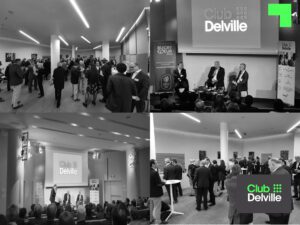
On Tuesday 12 April, Club Delville welcomed Claude Atcher for a breakfast to discuss the Rugby World Cup France 2023. It was in 2017 that France's bid to host the 2023 Rugby World Cup was selected — a first victory that marked the launch of the GIP (Groupement d'Intérêt Public), the body tasked with organising the 10th edition of this global event. To ensure the eight weeks of competition scheduled for autumn 2023 would be a success, Claude Atcher's teams were mobilised around several key areas: organisation, financing, management, logistics, ticketing, and the challenges and risks involved in hosting a major tournament on home soil. Over a breakfast organised by Delphine Phillipe (Club Delville Manager), followed by a conference led by Jean-Yves Marrec (Mission Director) and Patrick Abadie (Founder of Delville Management), Claude Atcher was first able to outline the various dimensions involved in organising a Rugby World Cup, before taking questions from the floor.
A matter of responsibility and leading by example
Rugby World Cup France 2023 was an opportunity to showcase France on the world stage through the French art de vivre, while also raising the profile of the sport within France itself in order to grow the number of registered players. Claude Atcher chose to compare the challenge of organising such an event to a rugby match. "We will need to stay focused and consistent right until the final whistle if we want to be able to say this event was a success." To deliver a world-class organisation, two guiding principles were adopted: responsibility and leading by example. It would therefore be essential to demonstrate that France deserved to have been selected ahead of countries such as South Africa and Ireland — historically two of the most influential nations in world rugby.

The Transition Manager White Paper 2021 – Transition Management: A Driver of Business Performance
Transition management raises many questions that we aim to address in this white paper. It is divided into four sections, each covering a different theme.
To better understand the context in which transition managers operate, this first section explores the transition management market — a dynamic market in which Delville Management is firmly established today.
Download the transition manager white paper no. 1" font_container=
Transition Management: A Driver of Performance
By ticking this box, you consent to Delville Management collecting and processing your personal data in order to respond to your contact request. This data is processed in accordance with our personal data protection policy. You may exercise your rights of access, rectification, erasure or objection at any time by contacting us at rgpd@delvillegroup.com.
Please leave this field empty.
Download
Delville Management in the Digital Business Magazine: "The Role of Transition Management in Times of Crisis"
Delville Management, transition management firm premium, featured in the Digital Business Magazine on the theme "The Role of Transition Management in Times of Crisis"
An effective method for navigating periods of growth, decline or crisis, transition management offers powerful solutions to help organisations manage major change. But what exactly does this type of management involve? What forms does it take, and what is its role in times of crisis?
What is transition management?
Having emerged in France in the early 2000s, transition management has been growing steadily ever since. This approach, highly valued by organisations undergoing transformation, involves calling on highly qualified management expertise to address an exceptional situation — in the short term and for a defined period. The objectives of a transition manager are wide-ranging:
- Supporting the organisation and its employees through crisis management (turnaround, site closure, restructuring, etc.) or positive change (launch of new services/products, workforce expansion, redeployment, etc.);
- Adding value across commercial, human, financial and environmental dimensions;
- Influencing systems, working methods, company culture and employees;
- Etc.
The goal of transition management is therefore to assist the organisation in implementing the changes it faces, while enhancing its competitiveness and performance.
The various forms of transition management
When an organisation engages a transition manager, they can operate across different levels and functions of the internal structure — including logistics, general management, procurement and human resources.
Beyond restoring internal operations and restructuring the organisation, the transition manager can also play a fundamental role in improving operational performance and strengthening employees' skills. Their expertise enables them to drive financial results and profitability as well.
Transition managers may work within consulting firms, such as Delville Management, or operate independently.
Read the full press article in the Digital Business Magazine by clicking here.
Transition Management in Numbers
Patrick Abadie, CEO of Delville Management, shares key figures on transition management. He reminds us that two conditions must typically be in place for a company to seek a transition manager: a management emergency and high stakes. The transition management firm, founded in 2010, carries out approximately 150 transition assignments per year.
External growth and mergers, digital and managerial transformation, cultural shifts and new economic strategies: to meet these challenges, organisations increasingly need targeted external support — which they find in experienced, adaptable professionals.
Delville Management: A Growing Talent Pool
On the supply side, both volume and structure are growing. Specialist firms benefit from an ever-expanding pool of experienced professionals who, for various reasons — including being sidelined professionally in their fifties — still have a great deal to offer other employers. In this regard, approximately 60% of transition managers are between 50 and 60 years old, according to data from Delville Management. "In general, two conditions are in place when a company calls us," explains Patrick Abadie, CEO of Delville Management, which he founded in 2010 and which carries out around 150 assignments per year. "There is urgency, and the stakes are high."
Assignments, which last only a few months, aim to put clients back on track — or to maintain continuity with the existing direction. Whether managing the consolidation of several acquired factories and rolling out consistent processes, executing a major transformation, or temporarily replacing a CEO, a supply chain specialist, an HR Director, or a project manager while a successor is found — or simply ensuring that employees are well supported during their manager's absence due to health or maternity leave — transition management is becoming increasingly mainstream.
Who uses transition management?
According to Delville Management's 2019 survey 1, nearly 50% of organisations using transition management are large groups or subsidiaries, followed by SMEs (28%) and mid-sized companies (19%).
For what types of assignments?
With a favourable economic environment, turnaround/recovery/restructuring assignments (20%) are declining in favour of assignments linked to business transformation and change management (80%), according to Delville Management.
For which functions?
The three functions most commonly served by transition managers are, in order: general management, human resources, and finance.
In which sectors?
One in two assignments is carried out in the industrial sector, according to Delville Management's 2019 survey. However, the services sector is growing and now accounts for 43% of assignments.
In which regions?
More than one in two assignments is carried out in Île-de-France. The next three most active regions are Auvergne-Rhône-Alpes (11%), the Grand Ouest (Bretagne, Normandie, Pays de la Loire) at 9%, and the Grand Est (7%).
What is the profile of a transition manager?
The majority are men (85%), with women representing only 15% of active transition managers today. Furthermore, 82% are over 51 years old (60% between 51 and 60, and 22% over 60). Additionally, 71% come from executive committee roles. More than 77% of managers have been choosing transition management assignments for at least two years, and 82% of respondents to the 2019 Delville survey had already completed multiple transition management assignments. In a highly dynamic market, nearly 60% of transition managers find a new assignment within three months.
For how long?
The average assignment lasts around nine months, but the number of assignments exceeding 12 months has more than doubled in two years, according to Delville Management.
(1) The Delville study was conducted between July and September 2019 via an email survey sent to nearly 1,300 transition managers.
Delville Management in AC Presse: "We Are Not in a Crisis of Confidence"
As President of Delville Management, a firm specialising in transition management, Patrick Abadie believes that France is not facing a crisis of confidence — and that the rebound should be very strong once lockdown is lifted.
You don't need to be a fortune-teller to see that a crisis is upon us. Yet this is not a crisis of confidence, unlike those of 2008, 1990 (with the Gulf War), or the historic crash of 1929. Founder and President of Delville Management, Patrick Abadie refuses to be "either optimistic or pessimistic" about the current situation. In brief, Delville Management is a firm specialising in transition management — that is, in the interim leadership of companies facing a management challenge. This places the firm in contact with a wide range of businesses across all sectors, making it an excellent vantage point.
Observation: the Covid-19 pandemic is affecting business sectors very unevenly. Outside of food retail, commerce is essentially at a standstill. Conversely, logistics is under enormous pressure, as is the agri-food sector, which is running at full capacity. With the launch of mask production, textile companies are overwhelmed. The same applies to the perfume and cosmetics sector, which is producing large quantities of hand sanitiser.
Read the full article "We Are Not in a Crisis of Confidence" in AC Presse
Career Profile of Frédéric Porcherot, Interim CFO
What is your professional background?
Frédéric Porcherot, Interim CFO: I graduated from the Ecole Centrale de Lyon with a generalist engineering degree, which is not the most conventional route into a CFO role. I began my career in management and organisational consulting for six years. This allowed me to broaden my engineering background and make the transition into my current role as a corporate finance executive. During those years as a consultant at Deloitte & Touche, I worked with banking and financial institution clients, developing two areas of expertise: one in organisational design and operations, and the other in management control and certain financial aspects.
I then moved into industry, and in particular the pharmaceutical sector, where I successively held two positions as Head and then Director of Management Control at Solvay Pharma and then AstraZeneca.
I subsequently moved into CFO roles, still within industry, in the specialised retail sector, where I have been operating for around ten years. I have held 3 finance leadership positions:
- within the Fnac Group (PPR), specifically in what was known as the Fnac Children's Division, comprising two separate companies — Fnac Junior and Eveil & Jeux — which were subsequently merged into a single entity, Fnac Eveil & Jeux;
- at Reebok, at the time of the merger with Adidas, where I held both the COO and CFO roles for France simultaneously;
- and more recently, at GAME France, a subsidiary of the GAME Group, the European leader in video game retail.
This gives me approximately twenty years of experience to date.
What have been your main areas of responsibility?
- I was tasked with setting up the management control function for one of my clients when I was a consultant, and with identifying and training their future management controller;
- I have been responsible on several occasions for implementing SAP information management systems, on projects of varying scale, including one international project covering 3 countries and all SAP modules, encompassing every function within a pharmaceutical group;
- At Reebok, I held two directorships simultaneously — CFO and COO. It was a dual role in which I greatly enjoyed broadening my scope to cover purchasing (direct stock procurement), customer service, and sales administration. This dual hat was fascinating because the combination of the two roles made me more effective in each: I could be a better CFO by having direct access to operational data to steer the business, while also being highly relevant in Operations by staying closely aligned with the Group's defined strategy and precisely targeting the objectives we had committed to;
- I have also been involved in several mergers and organisational integrations, again at varying levels depending on the case, from preparation through to execution: AstraZeneca (which at the time became the world's third-largest pharmaceutical company), Fnac Junior – Eveil & Jeux, and Adidas-Reebok. These are fascinating projects both from a human and technical standpoint, where you must address — in a concentrated period of time — every issue of strategy, organisation, processes, and structure that a company normally faces over much longer cycles;
- Finally, one of my other key responsibilities to date was working on the turnaround and rescue of Fnac Junior: a single objective — prove the concept was viable or close the business. We ultimately succeeded, and quite spectacularly at that, though we came very close to closure…
This gives me approximately twenty years of experience to date.
What are you most proud of in your professional career?
Without false modesty, there is more than one source of pride for me, as I have always thrown myself fully into every project. But undeniably, one stands above the rest — and it was also the result of a team effort. When I joined Fnac Junior and Eveil & Jeux, I had two very clear objectives on my brief, one of which was to work on the turnaround of Fnac Junior as quickly as possible, or to have to close the business. As mentioned above, we ultimately succeeded, but it was a long and arduous journey. At one point, when the decision to close the brand had almost been made, we took the initiative of convincing Serge Weinberg, the then head of PPR, to grant us an additional six-month window. We made Fnac Junior profitable, with a clear business model and a new development programme, thereby avoiding liquidation. Today, it appears that Fnac/PPR managed to generate sufficient value from it, as it was sold a few months ago as part of PPR's refocusing on other projects.
What are your areas of expertise?
I am a corporate finance executive who has not spent his career in a single sector: I started out in consulting for the banking and financial sector, then had two experiences in the pharmaceutical industry, and have now been operating for 10 years in specialised retail, with the advantage of mastering its various dimensions — across different channels (stores, e-commerce), B2C, B2B, pure distribution, and also the brand owner/equipment supplier side.
Within my areas of expertise, I like to present myself under several headings. I have developed strong organisational skills since the early days of my consulting career, which have run through all my subsequent experiences. I operate as a finance executive who works to develop and maximise business performance across all its dimensions: financial, economic and budgetary, certainly, but also in terms of ways of working, structures, processes, and tools — with the objective of improving, streamlining, and better systematising the organisation as a whole.
More broadly, I contribute to performance improvement — financial, operational, and organisational.
For me, numbers are not an end in themselves, but rather my raw material for steering the business. Drawing on financial and operational data, I enjoy taking a 360-degree view of the business to identify levers for improvement or growth. I position myself at the service of other functions and of Management, providing each with support, advice, and insight for steering their activity. I rely on genuine expertise in data analysis and interpretation to identify trends, errors, or successes, and to correct or build on them accordingly. This is the management control skill set deployed across the entire organisation — whereas it is too often confined to budgetary control alone.
What is your current situation?
My current situation is straightforward: I am looking for a new role. I had to leave my last position as CFO following organisational changes. After the departure of our France CEO, the Southern Europe CEO — who was also responsible for the Spanish subsidiary — decided to manage the French subsidiary himself with his Spanish leadership team. As a result, the entire French subsidiary management committee, of which I was a member, left the company.
Discover the profiles of our transition managers
To find out more about Club Delville, click here
Return to the blog home
